Tuesday, March 8, 2011

Caribou Hunt


 My First Caribou Hunt in the Arctic
(most photos by Jon Miller)

The Arctic National Wildlife Refuge

The Call

As distracting as it can be, I always enjoy picking up the phone at the Northern Alaska Environmental Center.  Answering our phone is like reaching your hand into one of those mystery Halloween boxes full of noodles or confetti, or eyeballs. I am never sure whether the person on the other line will begin yelling about our efforts to “shut down” a mine or admonish me for my formal “thank you for calling…how can I help you” and invite me to a potluck at their cabin.  On this particular late August morning, I answered the phone and a man named Jon Miller invited me to join him and a friend on a caribou hunt on the border of the Arctic National Wildlife Refuge.  Of that first conversation, the only words that I really heard were “go,” “Arctic Refuge,” and “September.”  I said yes before he finished the sentence. 

Getting Ready

            Reality trickled in slowly as I began to prepare for my first trip to this mythical place that has captured my heart, mind, and work plan, since high school.  The unknown is in many ways the essence of adventure, and judging by how little I knew going in, this seemed like a guaranteed adventure.  The hunting agenda, for example, was something that I had not really anticipated.  Desperate to secure my spot, on that first phone call I bragged, “I helped slaughter a pig on my study abroad in Thailand-- I don’t have any problem with killing animals.”  Nothing could have been farther from the truth.  Up until this point, I had never shot anything more potent than a laser tag gun.  When I was ten years old I threw a righteous fit when my dad tried to store a gun in our garage.  A classical product of my expensive liberal arts education, my car back in Michigan’s bumper sticker reads: “bare feet not arms.”  And my role in the “pig slaughter” had been to brace one hand on the pig and the other on my friend’s wrist, nurse-style, and grimace while another classmate stabbed the already unconscious animal in the heart.  When my boyfriend at the time tried to prepare me by taking me to the local Sportsman’s Warehouse and making me face up to the bevy of mounted animals, my toes curled and I retreated to trying on silly coonskin hats. 
To further complicate matters, I was packing for my first true arctic camping trip that was to take place in a month where snowstorms and ice fog were commonplace.  My gear fairies smiled knowingly and prepared me for a blizzard.  Over wine and chocolate, I described the few hazy details I had managed to remember about the trip to my boyfriend’s parents, long-time wilderness guides.  Carol half-smiled at my blind eagerness and Jim decided I was in for quite the trip, and packed me extra-thick socks and hand warmers. 
You know how you’re not supposed to go to the grocery store when you’re hungry?  Well I went shopping for this trip when I was hungry, excited, and expecting to freeze to death.  In this state of delusion canned peas and real potatoes seemed like reasonable pack food and I poured into my drybag enough heavy rations for about three weeks of Oregon Trail-style starvation. 
As I ran around like a squirrel gathering gear for a long, cold, winter, I also reached out to the people around me for guidance.  My friends were clearly jealous.  Aaron wrote: “enjoy the hunt, Miss Hertz.  I hope it is safe, successful, and full of beauty and meaning.  You know: like my outhouse will be.” Kaarle mocked concern, noting that bears are “attracted to ginger (both the color of my hair and the flavor of the chocolate I had stockpiled for the trip), especially before hibernating.”  In that arena, my parents back in Michigan expressed genuine fears about the fauna.  “Aren’t there bears there?” my dad worried, “how will you hang your food on the (treeless) tundra?”  Details I had no answer to.  At least my dairy-free, locavore, roommate was sensible.  Her parting words to me were, “bring us back some meat!” 

And So It Began

I woke up on the day of our departure full of that wonderful sense of precariousness that comes when you place your life firmly in the hands of near-strangers and resign to enjoy the ride.  Jon and Sven picked me up bright and early from the Northern Center in a packed-to-the-brim red Toyota.  I was meeting Sven, a German teacher at the local high school, for the first time and we immediately bonded in contemplating how on earth there was going to be room for any amount of dead animal in the overflowing truck.  “Relax,” I instructed myself as I climbed into the rigidly straight-backed backseat, “its an adventure.”  And so, like generations of slightly crazed settlers before us, we headed north on the only road that goes north- the Dalton highway.  This road parallels the famous trans-Alaskan pipeline all the way to its source: Prudhoe Bay.
Ten hours of snoozing, chatting, and daydreaming, were perforated by gas stops at places like Coldfoot, a town of about 30 founded in 1900 when green prospectors got cold feet and, according to legend, ran away.  I scampered in and out of the all-camo-clad-male truck stops in my long johns, ignoring boring stares and treating every flush toilet as if it would be my last.  We saw quite a few trucks puffing merrily back south with antlers on their roof.  I initially read this roof décor as a particularly grotesque display of masculinity, until I realized that it was practical- there was no other place to put them.  As we passed this parade of army green, I envied their success and wondered what it would be like to trade places.  I watched one particularly camo-fied and rotund hunter waddle painfully out of his car and decided to stick with my team.  As we bumped along, above the Arctic Circle, through Atigun pass, and into the purple Brooks Range, I chewed over the names of the rivers: Yukon, Koyukon, Kobuk, Sagavanirktok, Ivishak, Chandalar.  I felt that odd comfort that comes from moving uncontrollably into a new horizon.  I had few expectations and a lot of trust.

Getting Out:
When we arrived around 6pm that evening, we began the process that would perforate the next week: hauling.  Jon’s truck took the first leg of the work, driving up what is nicknamed as the “Haul Road.”  But once we reached what seemed to me a random spot along the otherwise unmarked Haul Road, the hauling was all human-powered.  Gear from truck to parking area, parking area to staging area, staging area to gravel bar, gravel bar to canoe, canoe to other canoe, in an attempt to balance weight and give Jon, the most experienced paddler, the most precious cargo. 
Our goal for that night was simple: get as far away from the road as possible.  Jon was understandably protective of his hunting grounds and didn’t want to be spotted. And we were all anxious to escape the lights and earth-shaking sensation of being near the highway’s large trucks.  So we pushed our canoes into the river and were quickly afloat.  After an all too brief paddle down the first river, we began lining up the second.  In layman’s terms, lining is pulling a canoe up the river.  And not necessarily by walking along the bank.  Most of the time we joined our canoes in the river, sometimes in water that came up to my chest.  Lining is a slight improvement over a sourdough technique called “poling” in which a person sits in their canoe and uses a large stick to move themselves against the current.  In Jon’s poetic terms, lining is like flying a kite.  Except that this kite contains all of your food and provisions for a week, and you had better not mess up. At first I felt a bit like Benjamin Franklin must have during his early kite and lightning experiments. 
After a few hours of battling the arctic river, we arrived at a sandy bank christened by caribou prints and made it our camp for the night.  We ate delicious caribou heart sandwiches packed by Jon’s wife, Lou, for dinner and sat around the Kelly Kettle (a small rocket-ship like contraption that we used to heat water) consuming cup after cup of tea.  Before turning in I climbed a knoll in the expansive arctic night and sat on its brink in silence for some time.  My heart was jumbled, but in the turning light I felt something stir in my core; I began to feel acutely alive.
The next day brought a fresh round of battling with the river.  Sven and I negotiated and re-negotiated the best way to share our lining duties.  Jon attached a “centerboard” to the bottom of our canoe to keep the boat sailing straight.  We promptly lost ours in the first set of rapids.  We attached a rope to the bow and a rope to the stern.  After another near dump, we figured out that it was best to have Sven in front, providing a slow and steady pull and me in the back, using my line to steer the boat, generally straight into the bank.  I quickly realized the true beauty of a solid bank.  The braided river in front of us presented a constant challenge.  Every moment felt like a calculation: deciding which way to go, when to cross, where the water would be rough, which layer of the looming mountains ahead was the site of our camp. 
I created a mantra, constantly instructing myself to relax and use the flow of the river.  I imagined that the river was like a horse.  My little sister’s warning about how the animal could easily read my level of stress circled around my head. So I strove to create a mutual level of comfort and respect, which is hard to do with a body of water that is constantly trying to knock you off your three-sizes-too-big to fit over waders- tennis shoes. 
As a scrawny kid, I once ditched my slower-than-optimal family on a hike through Glacier National Park in favor of a faster-moving foreign group that passed us.  For the first few minutes it was glorious.  My calves burned, my new comrades clamored in a foreign tongue, the trail sped by.  But after a few more minutes I began to swallow guilt.   I did not stop to examine the incredible rainbow pebbles as my sister would have.  I had given up access to my dad’s stash of trail mix.  I have long since learned to value the journey over the destination.  So on this trip up the river, I savored little moments: the reprieve of flat banks, the evolution of rain and mist swirling around us, frosty dewdrops of late-season blueberries that melted in my hands.  I paid homage to the technological triumph of Stacey’s new chest-waders by sitting down in the river on breaks.  Jon laughed, saying he had never seen anyone do such a thing.  I smiled, reveling in the buoyant resistance of my waders and wool against the playful river.  Leaning forward, I drank like a caribou, straight from the river.


Taking it in
Being a newcomer to this part of the world, I had no concept of how long our journey would be.  So when Jon turned to me with an impossibly large grin that could only mean one thing: “welcome home.” It took me three seconds of disbelief to accept that we had made it to camp and about three more to feel instantly at home in the grassy, unmarked riverbank.  Camp was a little river wonderland.  It was located along a gloriously flat bank, circled on all sides by hills and rises and held in place by a particularly flat and clear river delta.  To my delight, the hole-filled tundra was dripping with blueberries.  I scurried around, picking enough of the sweet treats to clear a spot for the tent and turn my teeth purple. Home for the next week consisted of two tents: an orange dome for sleeping and a blue and white striped tee-pee shaped one for cooking that reminded me of a circus tent.  Sven rigged a tarp in front of the sleeping tent like a covered front porch.  We parked out canoes on the riverbank, tying them in for the night.
 After dinner, Jon and I took a walk in the expansive arctic light.  “This is wonderful country!” he proclaimed, as we sloshed through the marshy field behind camp.  I smiled and felt something inside of me release.  I have spent a good portion of my life nodding along, pretending to see and understand things to satisfy my teachers.  Something about that first walk made me decide to quit the habit for good.  There was so much to learn!  I toted my journal around like a life vest, but I wanted to soak it all in through my skin. 
Looking back I don’t know how we ever managed to walk very far on that trip.  Every three steps I took I stopped, entranced at some new flower or lichen “what’s this one?”  A trained naturalist and nature-phile, Jon was the ideal guide.  He taught me how to walk on the tundra.  How to read the plants to find firm ground.  How to approach knolls with a slow and weary stride.  How to survey with my binoculars like a prairie dog.  What kind of terrain bears are fond of.  He gently lifted the “anchor” I was in the process of tying to a birch bush and showed me how to tie a low, twisted knot to keep the canoe in place in case the river rose.  Being in the wilderness requires constant vigilance.  We were far from help and the awareness of our self-reliance manifested in our every action.  That night we passed what I could only describe as a portal.  It was a tundra pool that had stratified layers in perfect, nuclear green and iridescent blue echoing circles.  Without a camera to capture it, we stood mesmerized at this odd gateway.  “Want to jump in?” I asked.  “Nah, I think I’ll take this world,” he smiled.  We never found the portal again.

Sven and I in front of a tundra pond

The Patterns of Life on a Hunt

Over the next few days we settled into the rhythms of hunting.  It was so gloriously unlike the backpacking and canoeing I had done before.  As we prepared for the trip, I wondered why Jon hadn’t asked me to bring more than one water bottle.  Growing up on backpacking trips in the lower forty-eight, I had come to think of water as a burden: something to bleach with iodine, worry about, carry.  In the arctic, we drank from the river.  This powerful act never lost its amazement on me.  I crouched down on all fours and drank like a lion from a watering hole.  It was pure, cold delight.  Coming from the land of rivers that catch fire, the idea of drinking straight from a river was almost more than I could comprehend.  I thought places like this had disappeared a hundred years ago.  Think of how much care and protection it takes to keep a river that pure.  I marveled at what a wide and complex system of protected land it takes to make that a possibility, and how quickly it can all vanish.
Wonders like drinking from the river became part of my daily routine, as hunting became life.  I began each day by throwing on layers of fleece and Jen’s old wool army sweater doing yoga in my extra-tuffs on the plain above the food tent.  Sven would start the Kelly Kettle and brew up a third, forth, and fifth round of his special green tea and Jon would bring out a bag of his delicious, extra-fatty homemade granola.  I assessed the weather conditions by standing still and staring, judging how thick my socks should be and which layers to pack.  Down to the river!  The patter began: untie the boats, cross the river, walk to a high point, and sit there.  Survey, relax, read, nap, write, capture, be.  That was our agenda. 

Caribou are illusive animals, we would often hike miles in pursuit of one and turn around to see a small herd right where we had lunch.  So the key was to be patient.  Waiting, was part of our task.  Instead of feeling guilty at taking a break as I would on a backpacking trip, I luxuriated in this time. I laid flat on my stomach and explored patches of the spongy, layered tundra world between my fingers.  I was forever investigating the haunting call of a solitary Pacific Loon, the hexagonal pattern, scars from permafrost on a dry field of tundra.   Our lives consisted of these little moments, miniature dramas that held our trio completely captivated. 

Instead of snow or ice fog, we had arrived amidst an Indian summer.  I spent most of the afternoons in just long johns, basking in the unlikely sunshine.  I reveled in tundra naps, drifting in and out of consciousness to find the most beautiful dreamscape possible, cradled between my arms.  We ended days reclining in the cook tent, drinking endless rounds of tea and telling stories.  I asked my companions about everything I could think of- from survival skills to their weddings.  In a rare period of no bugs and no snow, we slept with our heads at the edge of our open tent door.  From this position I could lean back and see the aurora.  Under the light of this strange, shimmering sensation, I had vivid dreams. Ken Brower once wrote, “the wilderness turns you in on yourself with such force.  You’re turned outward and inward, and amazing things start to happen inside your head.”  Twisting in many directions, I too entered a state where I couldn’t clearly discern the difference between dreamed and lived reality. 


The "dreamscape"

Taking Animals

Hunting was like a compound game of ring around the rosy and hide and seek.  Jon was the shooter.  He would spot a good group of caribou and set Sven and I up to spy on them while he chased.  We had to tuck ourselves into folds in the tundra and lie very still.  The caribou were very skittish and could smell us from a great distance, so we took care to remain upwind from them. Although we had advantages in weaponry, the caribou had a knack for keeping us humble.  On the forth day, Jon ran a good mile in pursuit of a herd and watched in dismay as they changed course and nearly ran into Sven and I.  “Sven,” I whispered, “what do we do if they run us over?”  “Stay put,” he breathed.  We held our breath as the click click click of their hooves came within range of a perfect shot.  My eyes fixed on the furry white chests of the two bulls that led the group. The bulls carried much more weight than the cows, and walked with a sway, their chests rising in unison.  The tension was almost more than I could bare.  I felt like a ten-year-old waiting atop a slide, aching for an audience to tell about a great adventure.
Later that day, we caught them at the right time and place.  A clear shot and an old buck fell to the ground in a slow, fluid motion.  Sven rushed and I ambled to the scene to find not one but four animals slowly changing worlds.  I approached with hesitancy.  Tears poured unconsciously down my cheeks as I reached out to touch their still-warm fur.  I was torn between the wonder and majesty of seeing such a complex animal so up close and the hard fact that we were ending its life to nourish our own.  I racked my mind for a prayer, something to say to honor this delicate balance.  But all I could think of was to affirm the goodness of life, as for the first time, I felt myself a distinct part of the circle. 
Processing one animal is a hefty task; disassembling four with two newbies on board seemed hopelessly huge.  My tears subsided as my hands set to work.  I would have many hours of washing, hauling, cutting, and cooking to read the direction of my moral compass on hunting. We had taken these animals, and for a moment my dilemmas were suspended by the knowledge that the best we could do now was use them.  Jon was a calm yet efficient teacher.  We rushed around to each animal, cutting into its stomach to stop it from bloating.  My brain circled on words like “rumen content” and replayed instructions and organs.  It was difficult at first, cutting into the flesh, pulling back the esophagus, allowing my hands to become full of blood and rumen content.  But soon enough parts of the process became oddly soothing.  The act of dissecting.  Making an incision and then gently peeling the skin back, slicing gently into the bubbly fat layers with sharp knives as you maintain the right tension.  Laying the skin out like a tablecloth, a workspace.  The rhythms of taking an animal apart.  It felt a lot like canning vegetables for the winter, making applesauce, or recycled greeting cards. 
As time passed we became a smooth-running team.  The guys put their year building a house together to use in sawing tasks and I became the “gut diver,” assigned with the task of salvaging the liver, heart, tongue, tenderloin, and back strap.  I expected a smelly mess, but was pleasantly surprised at the sweet, earthy scent of the caribou, the planned biological order of their bodies.  The way that their organs were neatly encased, intricately connected yet easily separable.  There was too much work for one day, so we separated the meat out in bags and loaded our backpacks with the best cuts of meat for the trek back to camp.  Only a few minutes into the trek, we were greeted with a sunset that made us unshoulder our hundred-pound packs.
In that classic way, the act of taking life enhanced my appreciation for the cycles of nutrients and life that fuel the earth.  Finding berry-stained antlers intertwined with the tundra reminded me of the cyclical nature of life without humans.  For the first time in my life I was really not afraid to die.  This feeling came not out of bravery, but from a deeper understanding of the circular patterns of life.  I could imagine no better fate than becoming part and parcel of this tundra world.  The power of nature, it seems, is the power of life in association.

John, Sven, and I model our VERY heavy packs

Other Tundra Life

            What about those grizzly bears?  You may be wondering.  I wondered too, but not with fear.  I have never felt so safe anywhere in the world as I did walking by myself in the refuge.  It is the kind of safety that comes from knowing that everything around you is in balance.  In the expansive, treeless tundra you can see for miles.  Binoculars enhance the experience, allowing you to witness nature as it is, to see up close but be at a distance.  How often do we get to see things simply as they are?
            Howard Luke, a much-adored Athabascan elder from the Fairbanks area, discusses luck as something you have to hold.  According to his tradition, luck is not a matter of odds and calculation.  Rather it is something that must be respected and maintained.  You maintain your luck by paying close attention to how you treat others and what animals appear to you as signs.  According to Howard, these animals use to be humans, and must be respected. 
I am still new to the act of reading animal signs, but it was difficult to ignore how our extraordinary luck with wildlife sightings.  Caribou made their presence known immediately.  “It looks like we just missed the caribou convention!” I remarked, after my first walk to gather firewood around the gravel bar of our camp.  One evening during dinner I glanced out of the tent and saw a perfectly framed large brown blob across the river.  “Bear!” I blurted.  “Musk ox,” Sven corrected.  I watched in awe as this giant, graceful cousin-it with horns ambled across the river, as if straight out of the Wisconsin ice age.  The next morning the same animal reappeared and paraded through the field behind our camp, and right into the perfectly framed picture: under a rainbow.  It would never again feel right to me to visit these animals in the confines of their farm in Fairbanks.
It seemed that each morning brought a new visitor.  One of my favorites was a lone white wolf.  It appeared in roughly the same spot, trotting attentively along the river.  It struck me how much this much-vilified wild animal resembled my Alaskan husky, Chandalar and nonetheless, took my breath away.  For a dinner show, we had a magnificent bull moose that strolled- uncharacteristically boldly, across the field, as if for our viewing pleasure.  We grabbed our life jackets and munched on cookie bars as the light changed colors across his 8-point rack.  Eager to practice for moose season, Jon thrashed some twigs together to call the rutting moose to us.  I protested at this idea that bringing a large, sexually charged moose into our camp with the idea that he was about to fight or mate.  Luckily, he seemed too absorbed in his stroll to mind us.  I could scarcely walk from one rise to another without finding a new treasure- blueberry stained antlers, a Short-Eared Owl feather, fossilized coral.  I found a sun-bleached ptarmigan egg, still whole, amidst the tussocks.  Before long I felt like one of those classic tourists, crossing off “wildlife sightings” in my journal.  Jon returned from a walk with a rare wolverine citing to add to my list.  The sky delighted us with Tundra Swans, Pacific Loons, and Northern Harriers.  We nearly hit a lynx driving back.

Not a Bear :)

Changes

            Nearly everyone that I have talked to that has spent a good amount of time about the Arctic has a certain glow in their eye.  It is a place that changes you in profound and mysterious ways.  The overriding sensation that I experienced in the Arctic Refuge was the feeling of being blessed.  It didn’t help that every time I looked down I saw Carol Kasza’s boots and super-warm socks.  I was kept the perfect temperature by Jen Landry’s wool sweater and Pam Miller’s gloves.  When I scanned the horizon for the next source of wonderment, I did so through Kyle’s, and before him, Mark Ross’s binoculars.  I used my dad’s headlamp and constantly collected antlers for my mom, who always dreamed of finding some.  I felt, for the first time the intense comfort of being mysteriously watched over, even if it was by the northern lights.  On one of our last nights, I took a long walk by myself under the stars.  The aurora was out and I couldn’t bear to retire to the tent.  I felt I might miss something.  So I curled up on the riverbank to watch and wait and quickly fell asleep.

A Parting Sign

            One of my favorite of Jon’s sayings was “that’s caribou for you.”  We said this with a mixture of exasperation and wonder at their unpredictable ways.  Some days we would hike miles to find caribou laying on top of our breakfast hill.  On the last day Jon had both feet in his dry suit and both boats packed when we heard Sven’s whistle.  Two bull caribou were literally parading through our camp.  We had one tag left.  Sven had to get back to prepare lesson plans, we apprehensive about the paddle ahead, but some things are too good to be constrained by time.  I smiled at Sven as Jon reached instinctively for his rifle.  We shot our last caribou.  It was the biggest yet. 

Sven models for his Christmas card shot

Bringing It Home


            I have always been of the belief that you should go with the flow of nature.  So my approach to whitewater canoeing with an 800 pound boat full of precious caribou was to go slowly, back paddle, communicate a lot, read the river, and use its tricks.  When he saw how nervous I was, Jon told me a story about the woman who had taught him to canoe.  As we prepared that morning, I conjured the presence of this woman: calm and competent in her mauve canoe.  Sven’s approach, on the other hand, was to build speed and use surges of power to dodge or ram obstacles.  It contrasted slightly with mine.  On the morning of our return paddle down the river both Sven and Jon were grim with worry.  As we tied and triple tied everything in, I tried to lighten the mood and my own growing anxiety with jokes and positivity.  They were lost on Sven.  Jon set the course, standing up to survey the river ahead and choosing whether to paddle or line sections, pointing out large rocks.  After a few hours of tense paddling, we saw a giant plume of dust- the road!  And just like that, our adventure changed.  There was still a great amount of work to do.  After more hauling, driving, and hauling, we spent a week cutting and wrapping the meat at Jon and Lou’s house.  As memorable as those hours before and after work were, something ended with the sight of that road.

The sunset over a tundra lake

Lessons 

            So what did I get out of my first trip to the Arctic Refuge?  A whole new palate of favorite colors.  A growing knowledge of the cycles of light and life.  A journal full of discoveries.  The ability to breathe from a place deeper down near my stomach.  And a big dose of hope- the kind of hope that comes from knowing just how much there is to fight for.

My favorite shot.


Thursday, March 3, 2011

Collections from FWS Arctic Refuge Symposium

“You collect all you can- so I collected birds, insects, and spiders.” –George Schaller, FWS Symposium on the Historic and Scientific importance of the Arctic Refuge, January 17-20, 2011) 

On my way to an 8am lecture, I passed by Rachel Carson’s typewriter, Olaus Murie’s unfinished painting, and Mollie Beattie’s boots.  As I walked into the auditorium, my eyes expanded in diameter to absorb nametags like “Zahneiser,” “Schaller,” and “Carter.”  In addition to reaffirming my hunch that I have to coolest job in the world, going to the Arctic National Wildlife Refuge 50th Anniversary Historic Symposium inspired me to do the kind of work that would merit an invitation to the refuge’s 100th anniversary celebration.

The symposium was organized by the U.S. Fish and Wildlife Service (FWS) to serve as a capstone for their 50th anniversary celebrations and “share history while many of the principal actors are among us.”  It took place on January 17-20, 2011 when a group of about 100 scientists, historians, politicians, activists, adventurers and students united by the Arctic Refuge, the “place that we all hold dear.”  convened at the FWS National Conservation Training Center in Shepherdstown, West Virginia.  Alaska FWS Deputy Regional director LaVerne Smith, set the tone, echoing Olaus Murie’s objective for his 1956 Sheenjek expedition: “to have a rich experience.”  Pam and I were present to represent the Northern Center.  Pam by giving a talk that addressed the elephant in the room: the historical difficulties of providing scientific information about the cumulative harm from of oil and gas sprawl and pollution that would occur if the refuge were opened to oil and gas development and me in my usual role of “sponge,” to absorb all sorts of new knowledge and contacts and to follow Olaus’s advice. 

The Arctic National Wildlife Refuge is the crown jewel of the National Wildlife Refuge System.  As former FWS Director Lynn Greenwalt put it, “there is nothing quite so formidable as a group of people committed to protecting a treasure.”  Over the years, the Refuge’s stunning mountains, braided rivers, intact ecosystems, and gregarious inhabitants have captured the hearts and inspired the careers of generations of visionaries from across the globe. 

The founders of the Arctic Refuge were not only protecting wild places, they were pioneering conservation.  The work of scientists like Olaus Murie, Brina Kessel, George Schaller, Keith Echelmeyer, Fran Mauer, and many more changed the field.  Working from the field, they immersed themselves in the places they studied.  These scientists did their learning on their feet and processed with their hearts as well as their minds.  They spent more time watching and less time manipulating nature.  They embraced the questions, accepting that most don’t come with neat or definitive answers.  Schaller told students, “the more you study, the more questions you have.”   Ornithologist Stephen Brown added “and if you get too much data, everything becomes mysterious again.”  Following Mardy Murie’s example they talked across boundaries and treated even their staunchest opponents with respect.  And perhaps most importantly, they worked to make conservation last through legislative means and by making it relevant and directly beneficial to locals. 

To be fair, the Arctic Refuge that served as their classroom and laboratory deserves some credit.  Symposium organizer, Steve Chase, made this connection when he described a moment he spent in the Firth River Valley.   Chase suggested that we apply this feeling of humility that the refuge taught him with the “strength and restraint that embodies conservation.”  This is the essence of holistic science and activism.  It is yet another reason why protecting our remaining wild places is so vital.  In Nancy Newhall’s words: “wilderness holds answers to questions man has not yet learned to ask.” 

The battles fought over the Arctic Refuge have challenged and shaped our concepts of wilderness, refuge, and conservation itself.  A testimony to this work, this “little corner of earth” in northeast Alaska remains largely wild and free today.  A testimony to the power of the place, for many of the founders, the Arctic Refuge is still the substance of their dreams.

Pam and I talk with George Schaller (!!!)
What to do with this legacy?  We can build museums, centers, and write histories.  Tom Butler suggested that refuge managers wear “W.W.A.D?” (What Would Aldo [Leopold] Do?) bracelets.  But the best way to honor the legacy of Olaus and Mardy Murie, George Collins and Lowell Sumner, Ginny Wood and Celia Hunter, is to build upon their inspiring example.  To protect the Arctic Refuge from a new generation of threats like global climate change.  “I think the founders would ask us to come up with our own big ideas,” reflected Conservation Fund representative, Brad Meiklejohn. 

In this realm I was heartened.  Fairbanks is and has always been heart of Arctic Refuge protection.  We are geographically closer to the Arctic Refuge than we are to Anchorage.  It is our backyard.  There were enough Fairbanks-based speakers present at the symposium to keep stories going until late in the night.  NAEC member Dr. Matt Nolan began his presentation on his family’s research at the McCall glacier with the words: “our whole lives are wrapped around this project.”  At dinner one night I met three young students who had spent their summers as FWS interns exploring the refuge and swimming in the Beaufort Sea no less than seven times.  This is the kind of holistic engagement that I imagine would make the founders smile. 

One of the most lasting impacts of this conference for a newbie like myself was the opportunity to interact with many of my heroes.  The conference was structured to encourage its participants to share and mingle.  Over the course of the week, I got to talk to Bob Krear about mountain lions, joke with George Schaller about finding Bigfoot, and listen to countless tales of bears and adventure from Fish and Wildlife employees who have been hard at work for more years than I have been living.  It was an empowering experience, to realize that so many of these incredible people were in Pam’s words, “just showing up” and in the process of pursuing their passions, changed the world.  In summary, I offer Sarah James’s humble conclusion about her decades of activism: “we have learned a lot; we’ve gained some friends to prove it.”
Sarah and I pose with caribou on our way to the bar :)


Friday, January 14, 2011

Walking Home

Fumbling through the bookshelves in my mom's office, I came across tthis essay that I wrote for the Passage (Kalamazoo College's study abroad publication) and found it oddly comforting, two years later.

Walking Home

After weeks of rising at the mercy of local roosters, I awoke one morning and found a world reverberating with a rare silence.  Sliding out of my bunk, my eyes met a friend’s and together we tiptoed out of the room of sleeping women into the damp world of rice fields. 

In a trance-like state, we traced our way through the jungle plants we were learning to identify, embracing the familiar banana trees and avoiding the menacing thorny rattan that sliced at our bare limbs.  The emerging sun bathed the forest floor in its restorative light.  We walked for walking’s sake, with no determined course or destination.

Walking was my form of meditation in Thailand, a way to process a foreign world in my own terms.  As we moved forward, I let me mind wander across my first few months abroad and sink into my building sense of guilt.  Everywhere I went, wonderful people had unquestioningly incorporated me into their lives.  Homes were offered, papaya sliced, beds laid out, but I had not felt at home.  In this intricate dance of sharing, I lacked the vital force that made the movement a genuine expression. 

A sorghum leaf swept across my shoulder, transitioning my attention to the jungle path before me.  The path was beat low, scarred by motorcycle tracks.  Farmers, I mused, bringing their fruit to market in Fang.  Or perhaps teenagers out on a joy ride.  Dense trees covered both sides of the trail, their sun-centered shoots creating a shaded tunnel. 

Walking through this metamorphic passage, I was overwhelmed by the feeling that I could be anywhere in the world.  The path recalled the simplicity of the woodchip-blanketed Michigan trails of my childhood, the intricacy of Japanese gardens, the rich mystery of an Israeli grove.   Inhaling, I felt these disparate threads of my life twisting together into an elegant knot.  For the first time, I felt at home.
Kelly walking

Tuesday, January 11, 2011

Frozen Frames (Alaska 3)

December 2010

Dear friends and family,

If you read no other part of this message read this: I AM COMING TO THE MIDWEST FOR THE FIRST THREE WEEKS OF JANUARY.  During this time, I would love to see as many of you as I can possibly fit.  As a shameless plug, I am currently accepting reservations for dinners, walks, and drinks of all caliber!  And now for that question I know you want answers to: 

So How’s That Alaska Winter Treatin’ Ya?


Winter
is the time when Alaska really hits its essence.
The land looks silhouetted like
A silvertip drawing.
As if someone took construction paper
And cut out shapes:
Barns and smoke stacks,
Rising ---
All too tangibly,
Dyed orange by a glowing sun.
The Alaska Range and Denali stand out.
Like paper cut-outs in a pop-up card.
No longer mistakable for clouds.
The Fairbanks Daily News-Miner calls this
the “thirty below glow.”
                                                                                               
"the Thirty Below Glow" from the Daily News Miner

Dark.

(sun worshiping)
First off, I feel obligated to clear ups some rumors.  Alaskans do not live in darkness all winter.  The farther north you go, the less sunlight, but at minimum there are at least 2 hours of daylight just about anywhere in the state.  Fairbanks is the farthest north “large” (65,000) city and right now the run rises around 11:00 and sets around 3:00.  I like to think of this as a more democratic schedule for the sun to take: the magic of the sunrise is no longer reserved for early-risers.  Rumor number two: day and night does not mean black and white, the remaining 20 hours are filled with shades of gray.  The snow has an odd way of retaining the light, its ice crystals lock in up for safe keeping.  Hours after the sun “sets” in stages of sherbert sky, the world retains a purple sheen.  When the moon is small, I use a headlamp to light my trips to the outhouse.  Even the dullest of lamps illuminates about 3,000 sparkles, as if everything is constantly being blown with pixie dust.  With the aid of this little light, I watch as my breath crystallizes before my eyes. 

The sun stays low in Creamer's field (taken during a lunch break run)
I came across a quote on my tea bag the other day: “those who realize that all is light are enlightened.”  Along with reaffirming my faith in the writers of tea wisdom, this quote made me realize that I have become a pagan.  The sun seems to be the thing most worthy of worship.  It’s not just me. With such a limited and then overabundant supply, there is a reason why “Solstice” and “Aurura” are among the most popular Alaskan names.  I read that the sun is the daily bread for the eyes.  But “daily bread” seems too worn-down, too religious, too much about sustenance and necessity.  I prefer to savor the sun by drinking it.  And when you’ve only got four hours of day, you had better make time to sip.  My original Alaska-guide, Stacey, described winter as a time when everyone leaves during lunch break to poke their heads out of windows like little groundhogs and bask for a moment in their daily dose of sun.   I haven’t quite hit that stage yet, but I’ve certainly changed my schedule around it.  Since skijoring to work in the dark when its – 26 degrees is just short of miserable, I’ve been hitching rides and going for runs in the middle of the day.  While some people tote sun lamps, pills, and tanning, I prefer to harness my true power as a redhead (we can store vitamin D!) and just enjoy being outside.  Just like anywhere else, you adjust. 

You can almost feel the warm light
Cold.
(Ways of Warming)
            There really is no sunny way of getting around the fact that I now consider ten degrees below zero “balmy.”  Going outside generally involves hunching my shoulders and bracing, and approaching door knobs with caution, like a pan straight out of the oven (they bite!).  Northern animals have had years of evolution to come up with awesome adaptations.  Wood frogs spend winter frozen in suspended animation, arctic ground squirrels can get their core body temperatures as low as 27 degrees before freezing, and chicadees expand their hippocampus (the part of your brain that controls spatial memory) by 30% to help them find thousands of food caches.  Humans, on the other hand, with our opposable thumbs and all their glory, have come up with some awesome and hilarious ways of coping. 

The first I would like to flag is a contraption called “bunny boots.”  Think what clowns wear but large, white, and on the feet of everyone from Salvation Army bell-ringers to my “suave” date at a fancy restaurant.  Bunny boots work their magic by harnessing the excellent insulating power of air (think platform shoes).  Second, there are dogs- it turns out that they are good for more than pulling you around!  You’ve heard of a three dog night, right?  The band I went to see with my parents.  Well in Fairbanks it’s a standard of measure, as in: “ah, I slept with all three of my dogs tucked in last night, must’ve been negative forty.” 

Our pup for the winter, Chandalar
Finally,  I offer for your consideration: cookies.  The perfect combination of sugar and fat.  Sara and I spent a Sunday baking lots and lots of these fat satchels.  In the spirit of being good northern neighbors and distributing the survival goods, we then drove around Fairbanks for an hour and a half (in a car with no heat) delivering bags of them to our friends along with goofy, anonymous notes like: "keep your goals away from trolls."   We approached each cabin slowly (out of caution and slow car), cut the lights, hopped out, and did the best ninja moves possible for two people clad in full-body down and squeaky boots.  Time and time and again, we were foiled by those damn motion-sensor lights.  Blinded by the sudden light-shower, we panicked, hurriedly dropped the bag of goodies by the door, and ran.  Blindly, giggling and shivering ferociously, over the ice back to the car.  Its harder to be sneaky when its -30.  Everything goes a bit slower than you plan.  .
As you know, there is nothing like being home for the holidays.  But if that means a $1,000 ticket and enough greenhouse gas emissions to completely negate all the biking, running, and skiing you have been doing for the past six months, then having a castaway thanksgiving dinner with 13 of your closest friends is a good alternative.  Being young, silly, and a bit poor, we arranged our day around the idea that we needed to eat twice, and exercise in between to revitalize our appetites.  The “exercise” of sledding on fragments of plastic over pure ice (this was right after ICEPOCALYPSE!!!) was pretty much negated by the fact that we made six different types of pie for dessert.  In order to get the full family experience, we came dressed as stereotypical family members and kept up the roles.  Since this was more of a party than thanksgiving, we did it again the next day, with Sara’s family.  Here I discovered the joys of Sog (soy egg nog) and helped to put up their Christmas tree.
As for my own holiday it actually dovetailed nicely with my newfound paganism.  Channuakh is, at root, a celebration of light.  It is an especially fitting holiday for Alaskans in December.  Seizing this opportunity, I put on a Chanukkah themed gourmet club night.  We made 3 loaves of my mom’s recipe challah, incredible gluten and dairy-free apricot noodle kugle, matzo ball soup, salad, homemade applesauce, latkes galore, and a “snora” (menorah made by putting snow in a bowl and inserting candles). 

My favorite spot, a little lake accessible from the trails in our backyard.  Note: the lake has chairs, our cabin does not.


Misery.
(Life on top of the world)
This heading seems to be a good place to insert a sentence about my trip to Hawaii.  I went there for a tournament called Hopu Ka Lewa, which means “catch the sky.”  A more literal translation would be: an incredible display of an organized dedication to the pursuit of silliness.  Highlights included eating Indian food off of Frisbees, parties with smoke machines and Taiko drummers, an actual pirate ship to conduct boat races on, daily costumes, and body surfing between games.  I spent almost a week before and after the tourney exploring the island and paid a grand total of $8.50 for one night of a campsite the entire time.  The rest of the time I resided in tents, Honalulu houses, a north shore surfer dude’s backyard, and a penthouse.  It was enough to renew my wanderlust. 

I returned from my magnificent tropical fruit binge on O’ahu to find Fairbanks in a state of ICEPOCALYPSE!   In a freak weather pattern unheard of by the sourdoughs (old-timers), it rained for four days straight at the end of November.  Schools, businesses, and even the Northern Center (where I work), shut down for the week and it was possible to ice skate on the streets!  This did a number on what appeared to be a very promising ski season.  As the temperatures dropped again to a sane -20, ice set in and made a very hard base under the trails and on the roads.  

Sara cleans the snow off her trusty car, Telulah

But then the snow came back.  And I’ve never been so happy to see snow.  The Inupiaq have (this is heavily debated by linguists at the Alaska Native Lanuage center) between 12-24 words for snow.  My favorite so far is the large rectangular flakes that look exactly like the Christmas display snow in malls.  Snow flakes are fractals- geometric patters that are repeated at every scale and defy being represented by classical geometry.  This repetition seems to be the key to their magic.
The snow is like a giant layer of padding.  It makes driving an adventure, getting up into our outhouse easier, countless marshy paths accessible, and falling a lot more fun.  Thirty some inches of the stuff has made the valleys and domes of Fairbanks into my personal winter wonderland.  When I first came here I understood the omnipresence of thermometers to be a way that Alaskans showed off the spectacle of their legendary cold.   Now I realize that the thermometer is a necessary tool in every day life.  It determines where you can go, what you can do, what you must wear, and how long you have to plug your car in or how much to feed your dog.  To run in the 20 below zone, I have to wear a gaiter that makes me look like a star-wars character.  Our executive director showed me how to drill screws into my running shoes and Jon found me a pair of brand new skis in the dumpster.  Still, no amount of star wars gear prevents you from looking like the abominable snow monster after more than 15 minutes outside.  At about five minutes in, my eyelashes frost in the most extraordinary manner.  Both top and bottom lashes collect small ice chunks and slowly, they freeze together. 

Mushing with Adele and Sara, those are my snowy mucklucks.
Aren’t you supposed to be working or something?
Ah yes, and on that front there is much going on  Our annual fund-raising auction that I spent much of October working on was a smashing, chaotic, success.  I made a cheesecake that sold for $120!  On December 6, the Arctic National Wildlife Refuge turned 50 years old and we gave it a party, a movie (America’s Wildest Refuge), a play (Wild Legacy), and an art opening (Jeff Jones Photography).   I am doing a bunch of grassrootsy organizing for an upcoming comment period and putting together a panel on environmental justice in the arctic for April’s powershift conference in DC.  We have two new faces at the office including the former head of the Fairbanks Chamber of Commerce, and a guy.  Pete is a bold man for agreeing to a position fighting mines in a mining town and working with seven women.  He is taking to the task in typical mountaineer fashion and livening things up a bit.  Last week he challenged me to a push up competition between staff meetings.  What is most exciting is that I am beginning a self-pioneered community history project to celebrate the 40th anniversary of NAEC.  So far this means that I get to do what I love most- listen to stories and find a way to communicate them to a broader audience. 

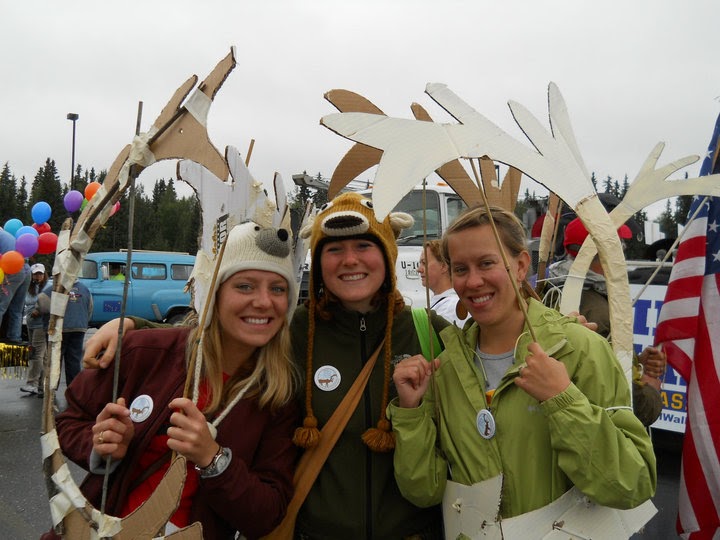
Hannah, me, and Stacey as Caribou in the Golden Days Parade this summer.
So how’s that Alaska winter treatin’ ya?
Good.  Its teaching me to see things in all sorts of light.


Frost lashes.